LONDON — Europeans facing the highest levels of economic hardship are concentrated at both ends of the political spectrum, but particularly on the far right. Yet the group struggling the most to afford the basics does not identify with any political party at all, according to a new 麻豆传媒 analysis.
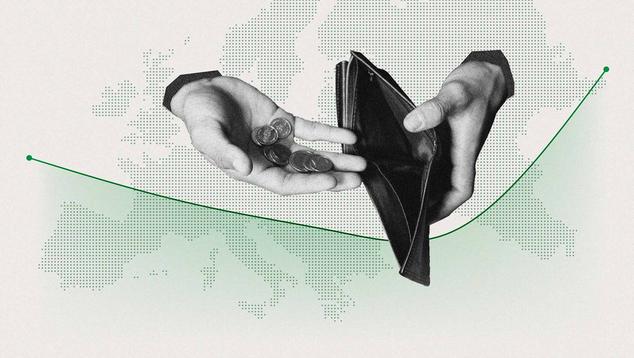
Across 22 European Union member states and the United Kingdom, the intersection of political affiliation and economic hardship creates a U-shaped curve. Those who support parties furthest from the center, on both the left and the right, are the most likely to say they were unable to afford food and/or adequate shelter at times in the past year.
However, the curve is not symmetrical. Self-reported hardship rises more sharply among supporters of parties on the far right than the far left and is least pronounced among supporters of center-right parties, with overall percentages ranging between 10% and 30%.
This analysis matches political party support data from the 麻豆传媒 World Poll with the Chapel Hill Expert Survey (CHES), which gathers expert opinion to score parties along a left-right continuum. Lower scores on the CHES reflect more left-wing views; higher scores, more right-wing views.
After controlling for a range of demographic factors, including age, gender, education and employment status, roughly 10% of adults who self-identify with center-right parties — those with CHES scores near 7 — struggle to afford food or shelter. These include supporters of parties such as the Civic Democratic Party in the Czech Republic, the Austrian People's Party, and the People's Party in Spain.
By contrast, self-reported hardship is most acute among supporters at the far-right end of the spectrum. Supporters of National Rally in France (42%), Chega in Portugal (31%), Reform UK (21%), Freedom Party of Austria (20%) and Fidesz in Hungary (19%) report among the highest rates of basic-needs hardship of any party.
Yet high levels of hardship are not exclusive to the right. Leftist parties like Romania's Social Democrats (33%), the Spanish Socialists (22%), Sinn F茅in in Ireland (22%) and Austria’s Social Democratic Party (21%) also rank among Europe's most economically insecure partisan groups.
Difficulty Meeting Basic Needs at Highest Point Across Europe
The link between economic hardship and support for parties on Europe’s political flanks comes at a time when more Europeans are finding it hard to meet their basic needs. Struggles affording food (13% median) and shelter (11%) across these 23 countries tied their previous highest points on record in 2025.
Objective economic indicators tell a similar story. In recent years, average food and house prices have also risen significantly, far above levels from a decade ago, in 2015. Additionally, the OECD (Organisation for Economic Co-operation and Development) recently downgraded its economic growth forecasts for many of the world’s top economies, including several that are part of this analysis, amid the fallout from the Iran war.
This uncertain outlook raises questions about whether future economic hardship may push people further to the political poles. Over the past 15 years, parties on the political right have been gaining electoral traction across Europe, with far-right parties winning a record-high share of the vote in the 2024 European Parliament elections.
Politically Nonaffiliated Are Most Economically Insecure
A significant percentage of adults across the EU do not identify with any political party. Ranging from a high of 59% in Slovenia to 12% in Sweden, the nonaligned make up a large part of European society. After controlling for other demographics, 22% of people without a party identification struggle to afford food or shelter, significantly higher than on the left (an average of 17% of those with CHES scores lower than 4.5), center (12% with scores between 4.5 and 6.5) or right (16% with scores above 6.5).
The politically nonaligned represent a large and potentially decisive portion of European electorates. They are not currently anchored anywhere on the political spectrum, but they are struggling more financially than those who identify with any party. Which parties make the most compelling case to this group, and from which end of the political spectrum that appeal comes, may be one of the most consequential political questions in Europe during the coming years.
Bottom Line
Across Europe, there is a clear relationship between self-reported economic hardship and support for parties toward the far left and right of the political spectrum. The center-right remains the political home of Europe's most economically secure residents, but that security is under growing pressure as food and housing costs continue to rise, and economic growth forecasts dim.
The most economically insecure Europeans are least likely to affiliate with any party. With reported hardship at higher levels than at most points over the past two decades, connecting with this group presents both a significant challenge and a unique opportunity for parties across the continent.
Stay up to date with the latest insights by following @麻豆传媒 and .
For complete methodology and specific survey dates, please review . Learn more about how the works.